Run your servers like
you run code.
Branch, diff, tag and roll back live servers. One panel for every host you run.
Bring servers from any provider
git branch, but for the running server.
A running copy of a ComputeForge server on its own firewalled address, in a minute or two. Break the copy, not prod. Servers at other providers: Coming soon
How it worksSee what changed, when, and who did it.
History, diff and blame for every tracked file on the box, in the panel and the API.
How it worksTag the known-good state. Roll back in one click.
Restore a tag's files on any connected server that allows remote changes, with no downtime. A whole server comes back on our cloud, same IP.
How it worksgit push, but it's your VM moving providers.
Copy a running server to another provider on the same Linux release, cut over when ready, roll back for 24 hours.
How it worksOne panel for your servers.
Servers, volumes, snapshots, networking and access, in one place.
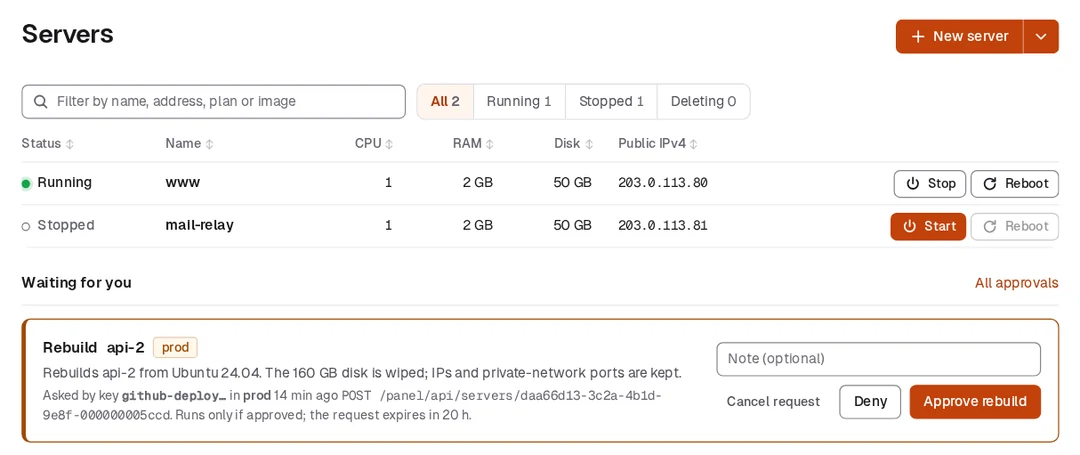
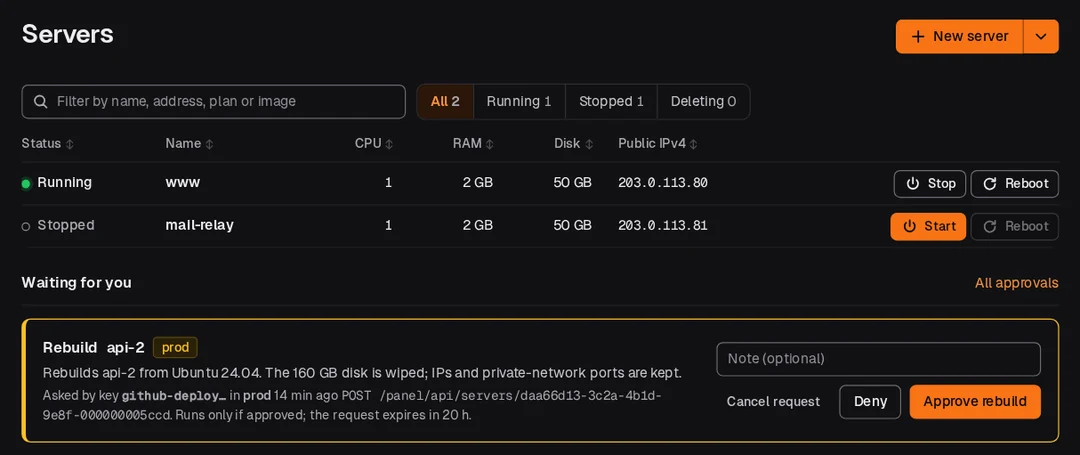
DNS that fails over when a probe goes red.
Lifeguard probes any VM; Forge DNS swaps the record when it falls and notifies you.
How it worksStop being on call. Start being protected.
Spot an anomaly, scan, propose the fix. You decide how much it may do on its own.
How it worksDescribe your stack once.
Services, dependencies, standbys and autonomy in one YAML file, or in plain English.
How it worksEvery server on one private network.
One click puts a connected server on your WireGuard mesh. Laptops and homelab boxes can join too.
How it worksAI that reads the diff.
A plain-English reading of what changed, and a suggested fix you can apply or ignore.
How it worksBackups in a format you own.
A checkpoint into your own Borg or Restic repository, with a passphrase only you keep. DNS zones as BIND, mesh as plain WireGuard.
How it works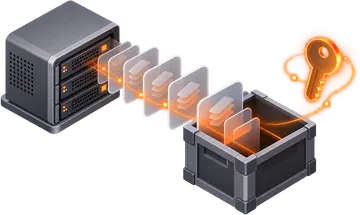
Stop trusting the OS to tell you the truth.
A scan checks the disk against what the OS reports and against package hashes, to catch hidden files and swapped binaries.
How it worksChange the server you have. Don't rebuild it.
More RAM, a bigger disk or a different OS should not mean starting over. These are the tools for changing the server you already run; the ones marked “Coming soon” are built but not open to every account yet.
Archive a server, keep it for later
Done with a server but not ready to lose it? Archive it into protected storage, download it as a standard disk image, and restore it when you need it.
Old branch snapshots into object storage
Promoted a branch? Move the snapshots it was made from into object storage. The copy is checked in full before the snapshots are removed, then sits under Archive, billed at the object storage rate.
Backups in a format you own
Export a tagged checkpoint into your own Borg repository, encrypted with a passphrase only you keep. Restore it on any Linux box.
Know before your customers do
Health checks on any server, alerts by e-mail, Slack, Discord, ntfy or webhook, and DNS that fails over when a check goes red.
Checkpoints and branches
Tag a known-good state and roll back to it. Branch a running copy of a server on our cloud and try the risky change there first.
Scan the disk from outside the server
Rootkits lie to the OS. On our cloud the integrity scan reads a copy of the disk from outside the server and checks its files without trusting what the OS reports.
Pay by the second
Delete a test server after ten minutes and pay for ten minutes (at least one cent). Or pay the monthly rate for a server that runs all month.
More CPU and RAM, no restartComing soon
A traffic spike should not mean a reboot. Add CPU and RAM to a running server, take them back off when it is quiet, and pay for the extra by the second while it is there.
RAM that follows the loadComing soon
Set a floor, a ceiling and a spending limit. The server gets more RAM when it runs short and gives it back when the load drops.
Grow the disk while it runsComing soon
Disk full? Make it bigger without stopping the server. The panel shows how to grow the file system: at the next restart, or right away with one command.
Shrink the disk to a smaller planComing soon
Paying for disk you never use? Move to a smaller plan without reinstalling. Your data comes along, and you can undo it if something looks wrong.
Boot your own ISOComing soon
Need an OS we do not offer, or your own rescue tools? Boot a server from an ISO, from a web address, an upload or your own bucket, then detach it.
Host with us when the verbs need our metal.
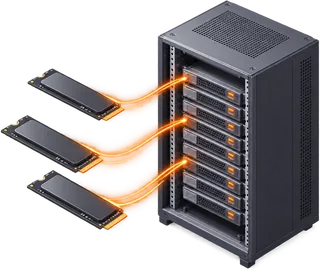
Per-second billing
Delete a CI runner after 17 seconds, pay for 17 seconds (at least one cent).
A person to talk to
A question about a charge or a stopped server goes to a real person, through a support ticket in the panel. Your activity log is private to you and your team.
Open-format export
Export a checkpoint into your own borg repository over SSH, encrypted with repokey-blake2 and a passphrase only you keep. Download any DNS zone as a standard BIND zone file. Export your mesh as plain WireGuard configs: we never hold your private keys. Your data, your format.
The verbs across providers.
The verbs run over a small agent you install with one command from the panel. Full comparison →
| Capability | ComputeForge | DO / Hetzner / Linode | Datadog / PagerDuty | Pulumi / Terraform |
|---|---|---|---|---|
| Change history for any server | ✓ | — | partial (events only) | — |
| Diff between two servers | ✓ | — | — | — |
| Branch a running server | Coming soon | — | — | — |
| Tag + restore | ✓ | partial (snapshots) | — | partial (state files) |
| Health-check-driven DNS failover | ✓ | partial (LB health checks) | partial (alerts only) | — |
| Cross-provider mesh | ✓ | — | — | — |
| cf push between providers | Coming soon | — | — | — |
| Capability | ComputeForge | DO | Hetzner | Linode | AWS |
|---|---|---|---|---|---|
| Per-second billing (servers, volumes, snapshots, IPs) | ✓ | partial (Droplets only, 60 s min) | — | — | partial (60s min) |
Pick a plan. Pay monthly or by the second.
ComputeForge cloud servers, in US dollars before tax. Per-second billing costs about 20 % more than the monthly rate.
Cloud 1 GB
- 1 GB memory
- 1 vCPU AMD EPYC
- 25 GB NVMe
- 1 TB bandwidth / month
- 1 IPv4 + free IPv6
Cloud 8 GB
- 8 GB memory
- 4 vCPU AMD EPYC
- 200 GB NVMe
- 4 TB bandwidth / month
- 1 IPv4 + free IPv6
Cloud 64 GB
- 64 GB memory
- 20 vCPU AMD EPYC
- 1.6 TB NVMe
- 7 TB bandwidth / month
- 1 IPv4 + free IPv6
Cloud 128 GB
- 128 GB memory
- 32 vCPU AMD EPYC
- 3.2 TB NVMe
- 9 TB bandwidth / month
- 1 IPv4 + free IPv6
Run your servers like
you run code.
Sign up, add a card, create a server. Delete it any time.